Tyres on a Range Rover in the UAE face a uniquely punishing combination of challenges. Scorching tarmac that regularly exceeds 70°C in summer, abrasive sand on every road surface, and the relentless succession of speed bumps across Dubai and Abu Dhabi streets — all conspire to wear rubber faster and less evenly than in milder climates.
The good news: a disciplined rotation schedule, precise four-wheel alignment, and a few heat-aware driving habits can add thousands of extra kilometres to each set of tyres — and save you thousands of dirhams in premature replacements.
Ready for a rotation and alignment set to factory ride height? Book your Range Rover tyre service at Euro Expert in Dubai.
Why UAE Conditions Accelerate Range Rover Tyre Wear
Heat is the silent killer. When ambient temperatures push past 45°C, road surface temperatures climb well beyond 60–70°C. This softens the tyre compound, increases rolling friction, and accelerates tread degradation.
Couple that with fine desert sand acting like micro-abrasive sandpaper on the contact patch, and you have a recipe for premature hot-climate tyre wear that no European or North American rotation schedule accounts for.
Tyre Wear From UAE Speed Bumps and Sand
Dubai and Abu Dhabi streets are lined with speed bumps. Each impact:
- Loads the front suspension and compresses the leading edge of the tread
- Creates localised cupping and feathering
- Gradually knocks alignment out of specification
Sand compounds the problem. It packs into tread grooves and wheel wells, retains heat, and acts as a constant abrasive against the rubber surface. Together, speed bumps and sand create wear patterns that set in far sooner than most owners expect.
How Often to Rotate Tyres in Dubai Heat
Most manufacturer handbooks recommend rotating tyres every 10,000–12,000 km. In the UAE, experienced technicians suggest reducing that to every 7,000–8,000 km — roughly every other service visit.
The logic is simple: faster wear means patterns set in sooner. Once cupping or feathering becomes visible, rotation alone won’t fix it. Rotate early, rotate often, and save the cost of an early replacement set.
Best Range Rover Tyre Rotation Pattern in the UAE
Square setups (same size all round)
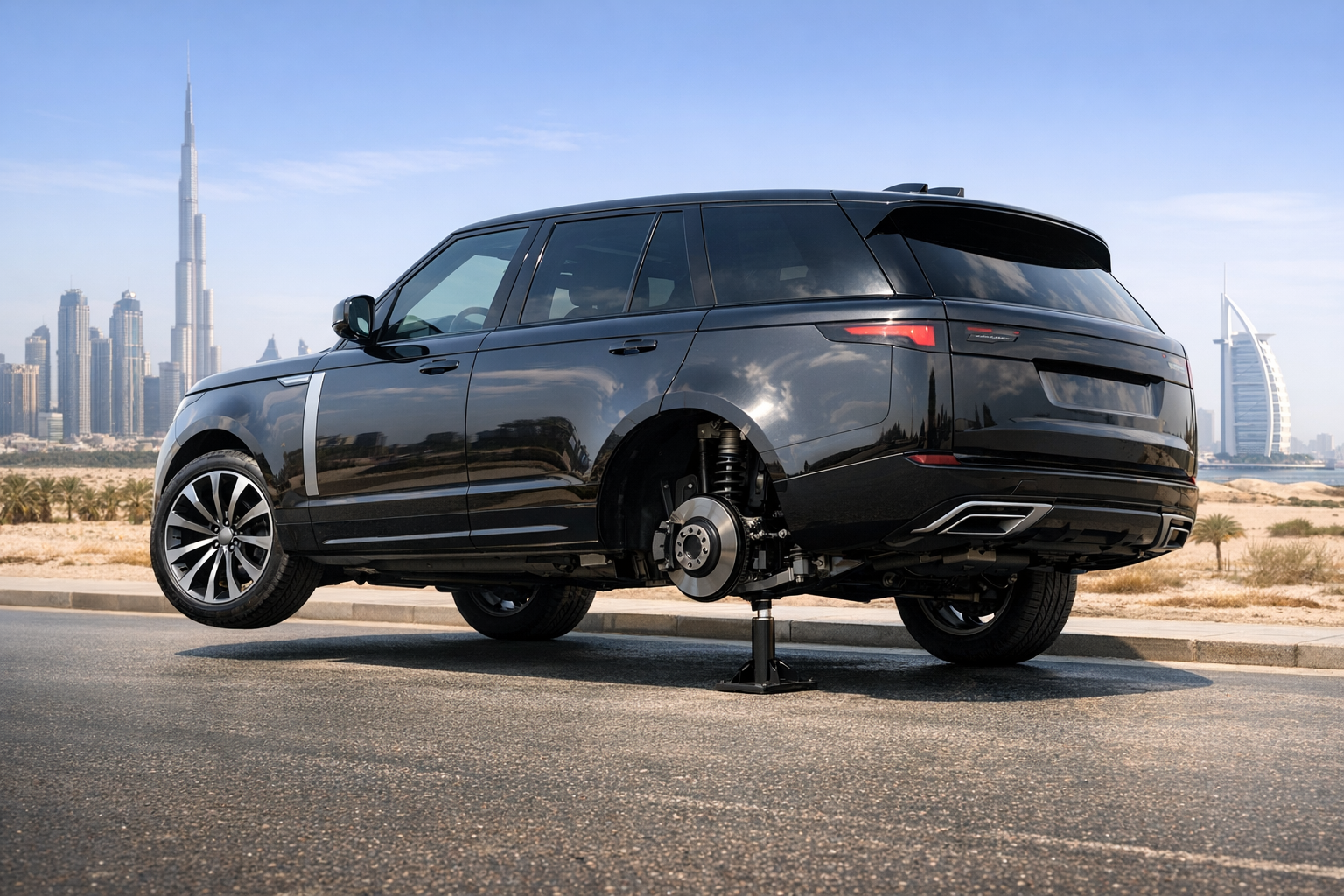
The majority of Range Rover models — Vogue, Sport, Velar — leave the factory with identical tyre dimensions front and rear. For these 4×4 SUVs, a cross-pattern rotation distributes wear most evenly:
- Front-left moves to rear-right
- Front-right moves to rear-left
If your tyres are directional (check for an arrow on the sidewall), you’re limited to a front-to-rear swap on the same side.
Staggered setups (wider rear tyres)
Some Range Rover Sport SVR and customised builds run staggered widths. Here, you can only rotate front-to-front and rear-to-rear (side swap). With fewer rotation options, alignment precision and inflation discipline become even more critical.
Range Rover Tyre Alignment in Dubai: The Non-Negotiable
Speed bumps don’t just wear tyres directly — they knock alignment out gradually. A toe or camber deviation of just 0.5° can shave 20% off tyre life.
UAE alignment recommendations:
- Full four-wheel alignment check every 10,000 km
- Immediate check after any significant pothole or speed-bump impact felt through the steering wheel
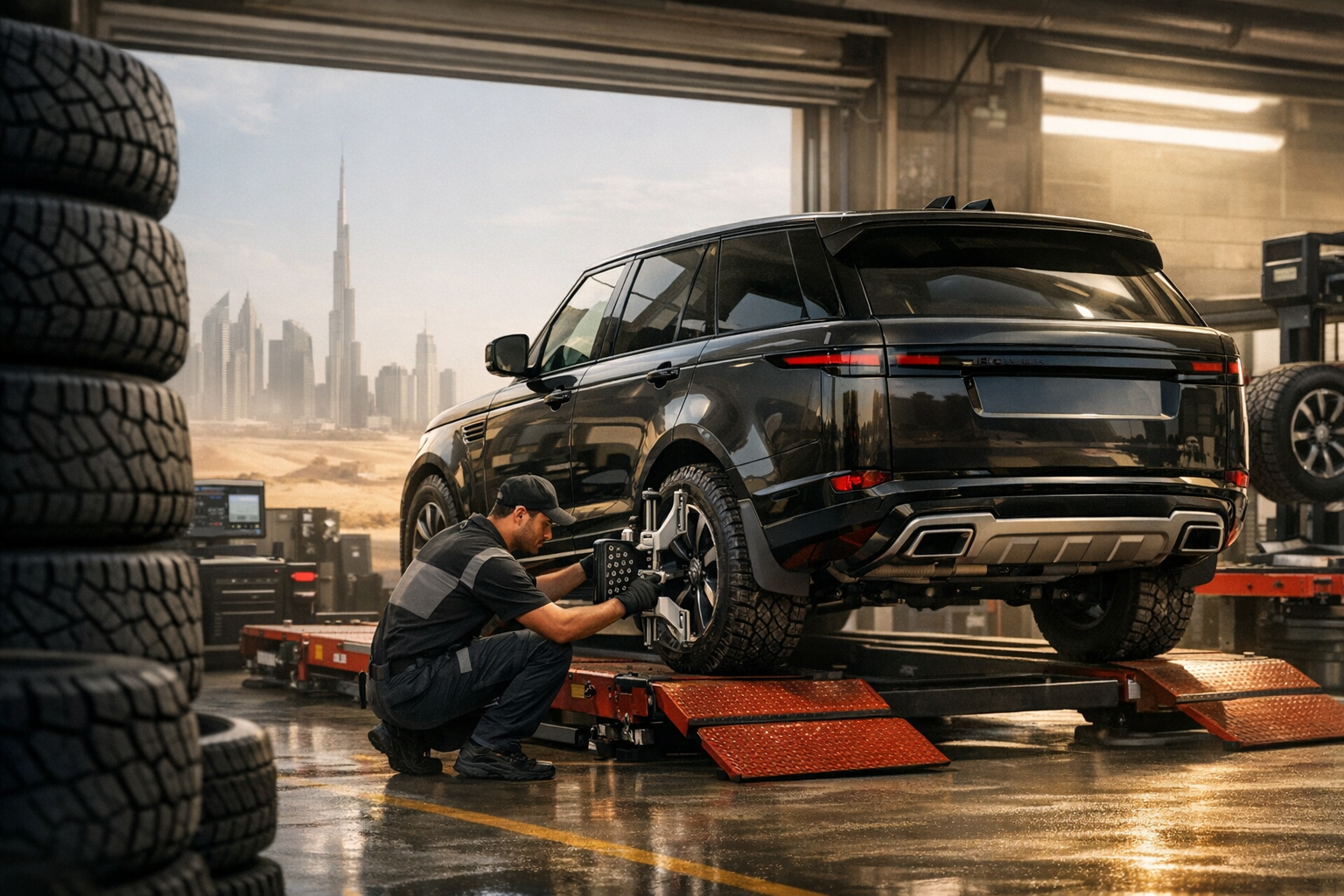
- Alignment performed at correct ride height for air-suspension models
That last point is critical. Range Rover air-suspension systems must be at factory-specified height for alignment readings to be accurate. Generic tyre shops sometimes miss this detail. The trusted Range Rover repair specialists at Euro Expert in Dubai calibrate alignment at factory ride height, ensuring adjustments hold true across all driving modes.
Heat-Aware Habits That Extend Tyre Life
- Check pressures cold, every 2 weeks. Under-inflation by even 3–4 PSI increases sidewall flex, generates internal heat, and accelerates shoulder wear. Always measure before driving or after the vehicle has sat for 3+ hours. Keep to the door-jamb specification — heat raises pressure while driving, so cold readings are the only accurate baseline.
- Avoid prolonged high-speed motorway runs in peak afternoon heat. Driving at 140 km/h on Sheikh Zayed Road in July pushes tyre core temperatures to levels that degrade the compound internally — damage you won’t see until it’s too late.
- Approach speed bumps squarely and slowly. Hitting them at an angle loads one shoulder disproportionately and stresses sidewalls unevenly.
- Park in shade wherever possible. UV and radiant heat age sidewall rubber, leading to micro-cracking that weakens structural integrity regardless of remaining tread depth.
- Wash sand from wheel wells and tread grooves regularly. Packed sand retains heat and grinds away at the rubber surface with every rotation.
How to Spot Uneven Tyre Wear Early
Catch problems before they become expensive:
- Feathering: run your hand across the tread — if edges feel sharp in one direction, alignment is off
- Cupping or scalloping: dips around the tread circumference, often from worn suspension or infrequent rotation
- One-sided shoulder wear: typically under-inflation or camber misalignment
- Steering pull: the vehicle drifts left or right on a flat, straight road
- Vibration at speed: possible balance issue or internal tyre damage from heat
If you notice any of these signs, rotate immediately and book a four-wheel alignment before the pattern worsens.
FAQ: Range Rover Tyre Rotation and Wear in the UAE
How often should I rotate Range Rover tyres in Dubai?
Every 7,000–8,000 km due to accelerated wear from heat, sand, and speed bumps.
What’s the best rotation pattern for a Range Rover?
Cross-pattern on square setups (same size all round). Front-to-rear same-side if tyres are directional.
Do UAE speed bumps affect alignment?
Yes — check four-wheel alignment approximately every 10,000 km, or after any hard impact.
Should I change tyre pressures for summer in Dubai?
Keep to the manufacturer’s door-jamb specification. Check cold every 2 weeks. Heat raises pressure while driving, so only cold readings are accurate.
How do I spot uneven wear early?
Look for feathering, cupping, one-sided shoulder wear, and steering pull. Rotate before patterns set in.
Does a Range Rover need alignment at a specific ride height?
Yes — air-suspension models must be aligned at factory-specified height for accurate readings. A marque specialist ensures this is done correctly.
The Bottom Line
Tyres are the single most important safety component on your Range Rover, and in the UAE they’re under siege from the moment they touch the road. Shorten your rotation interval to every 7,000–8,000 km. Insist on precise four-wheel alignment from a specialist who calibrates at factory ride height. Adopt heat-conscious habits year-round.
A small investment in discipline today means safer, longer-lasting rubber through every UAE summer — and fewer surprise bills at the tyre shop.
Keep your Range Rover Sport, Vogue, or Velar tyres lasting longer through Dubai’s toughest conditions. Book your Range Rover tyre rotation and four-wheel alignment at Euro Expert today.