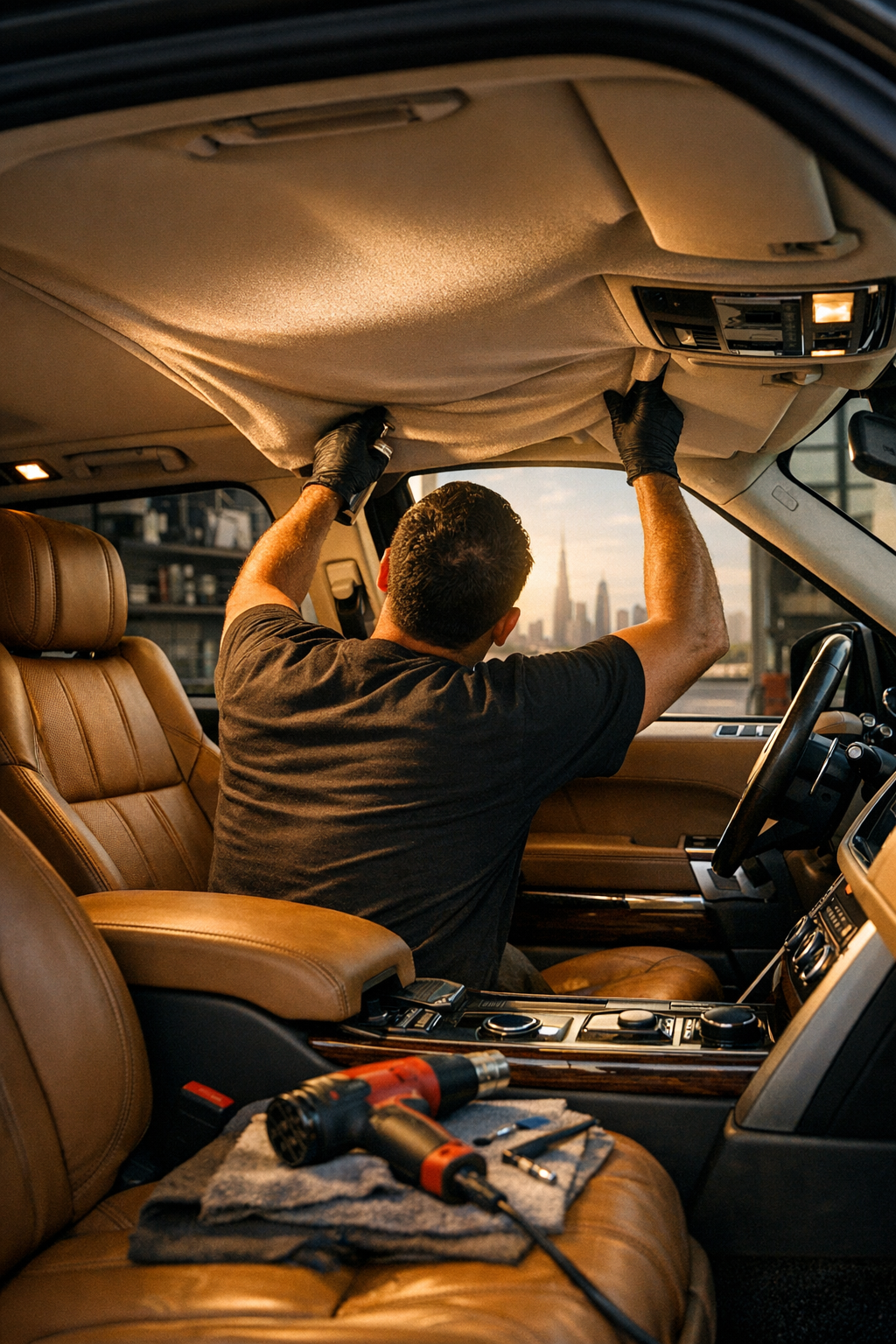
Owning a Range Rover in the UAE means contending with driving conditions that few other markets can match. Between scorching asphalt temperatures that regularly exceed 60 °C at surface level, an endless procession of speed humps across residential and commercial districts, and the temptation of weekend desert adventures, your suspension geometry and wheel balance are under constant assault. Understanding how these factors accelerate tyre wear — and what proper four-wheel alignment and road-force balancing look like for an air-suspension-equipped SUV — can save you thousands of dirhams a year while preserving the refined ride Range Rover is known for.
How UAE Heat, Speed Humps and Desert Tracks Attack Range Rover Alignment
Extreme Heat and Tyre Wear in Dubai and Abu Dhabi
High temperatures soften tarmac and increase tyre flexibility, which amplifies the effects of even minor misalignment. A toe angle that might cause negligible wear in a temperate climate can shave millimetres off a tread edge in a single Abu Dhabi-to-Dubai summer commute season. Heat also accelerates rubber degradation at the control arm bushings and toe links, allowing camber, caster and toe angles to drift out of specification faster than the factory service schedule anticipates. The result is premature inner shoulder wear on front tyres and a vague, unsettled feeling at motorway speeds of 100–120 km/h.
Speed Humps and Front-Axle Geometry Shift
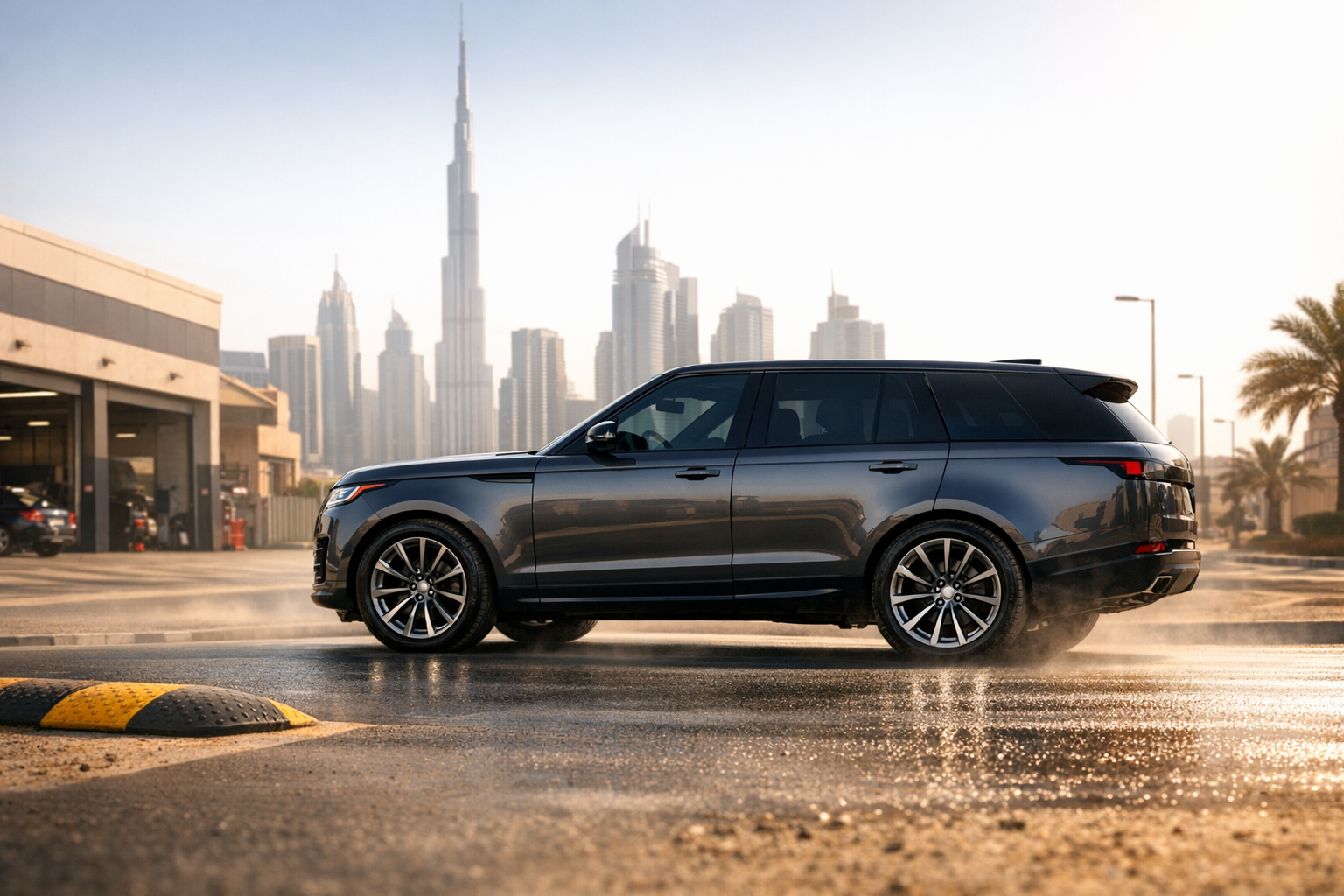
Dubai alone has thousands of speed humps, many of them unmarked or inconsistently shaped. Each impact loads the lower control arms, tie rods and air-spring mounts. Over time, repeated compression events shift camber and caster angles — particularly on the front axle of the Range Rover L460, L405 and Sport L461 — creating an asymmetric wear pattern where the inner shoulder of one front tyre wears noticeably faster than the other. If you notice your steering wheel sitting slightly off-centre despite driving straight, or experience a mild steering pull, speed-hump-induced toe shift and thrust-angle deviation are likely culprits.
Desert Driving and Rear-Toe Misalignment: What Dubai Owners Should Check
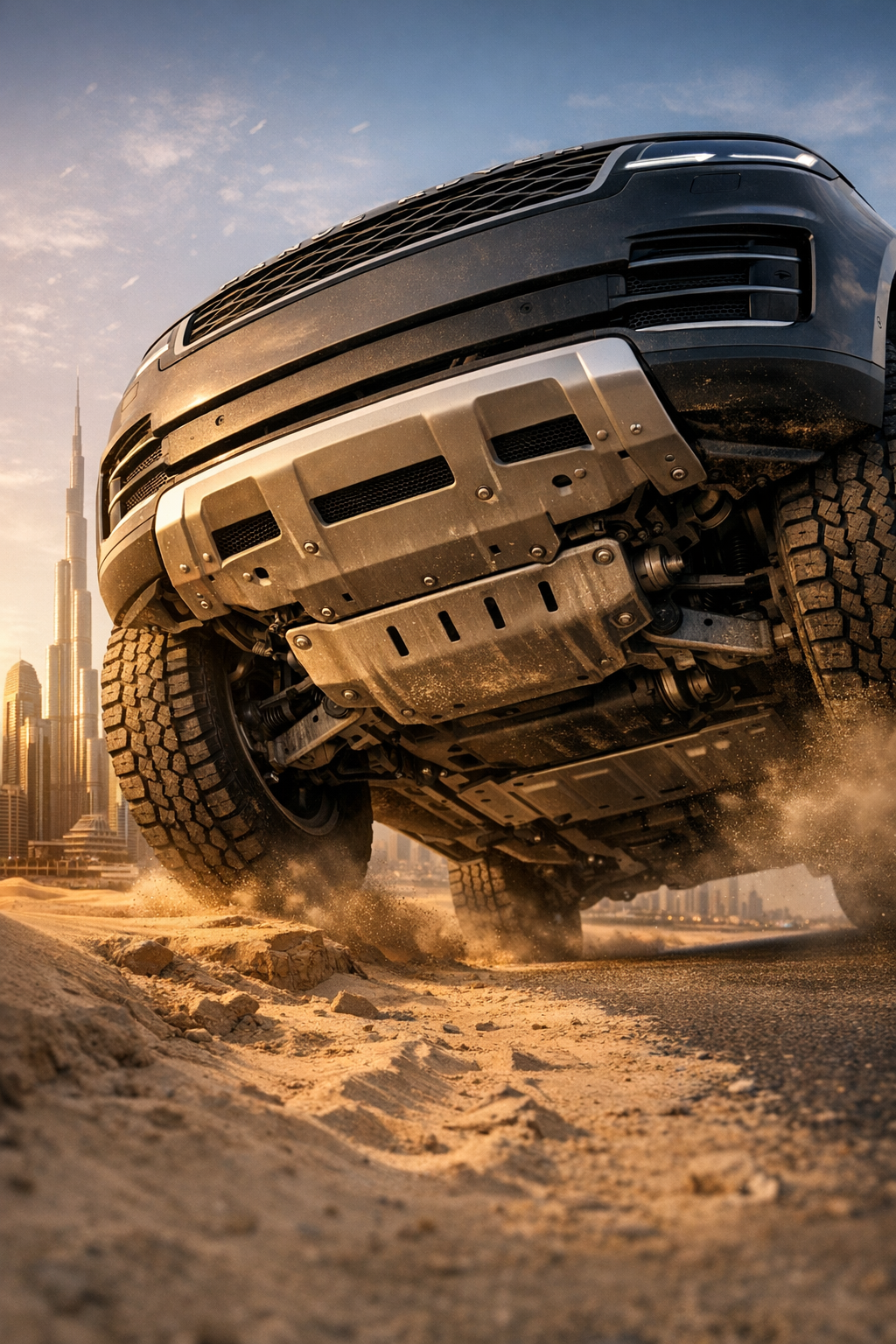
Sand tracks, gravel beds and dune approaches subject the steering and suspension to lateral loads the system was not designed to sustain continuously. A single hard side-impact against a hidden rock or rut lip can bend a tie rod end or knock a rear trailing arm and toe link out of position. Because Range Rover models — including the Sport L494, Velar and Evoque — use independent rear suspension, rear-toe misalignment is common after off-road excursions. It often goes unnoticed until the rear tyres develop a feathered, diagonal wear pattern or you feel wheel vibration at 100–120 km/h that was not there before the trip.
Signs Your Range Rover Needs Wheel Alignment in Dubai
Watch for these telltale wear patterns during your regular tyre rotation or visual inspections:
- Inner-edge wear on the front tyres — excessive negative camber or toe-out, common after speed-hump fatigue on the L405 and L460.
- Outer-edge wear on the front tyres — positive camber drift, often from worn upper arm bushings softened by UAE heat.
- Feathering or diagonal scalloping on the rear tyres — rear-toe misalignment after off-road use, especially on the Sport L494 and L461.
- Centre-strip wear — over-inflation, frequently caused by owners who forget to adjust pressures back down after airing up post-desert.
- Cupping or patchwork wear — wheel balance issues or worn dampers failing to keep consistent tyre contact. Road-force balancing is the definitive fix for 21–23 inch wheels.
- Steering pull to one side under braking or steady cruise.
- Steering wheel off-centre when driving straight on a flat road.
If any of these sound familiar, book expert Range Rover wheel alignment in Dubai with Euro Expert.
How Often to Align and Balance in the UAE Climate
The factory recommendation of checking alignment every 20,000 km assumes moderate European conditions. In the UAE, specialists who work exclusively with Land Rover and Range Rover models typically recommend a four-wheel alignment check every 10,000 km — or immediately after any desert outing, pothole strike, or new-tyre fitting. Balancing should be verified at the same interval, since heat cycling and kerb scuffs shift weight distribution on the rim more frequently here. For owners running 21, 22 or 23 inch wheels, road-force balancing is strongly recommended over standard spin balancing to eliminate vibration and prevent cupping.
Air-Suspension Alignment: Range Rover Specs for L460, L405, L494, L461
This is the detail most generic tyre shops overlook. Range Rover models with Electronic Air Suspension (EAS) must be set to the correct ride height — and that height must be stable and even across all four corners — before any alignment readings are taken. If the vehicle is sitting 8 mm low on one side due to a slow air-spring leak or a faulty height sensor, every angle measured on that corner will be wrong, and the resulting correction will actually make things worse.
A qualified specialist will connect to the EAS module, command the system to standard ride height, verify all four height sensors are reading within specification and allow the suspension to settle before clamping alignment heads. This single air-suspension height calibration step is the difference between an alignment that lasts 15,000 km and one that shows wear within 3,000.
Models that require this procedure include the Range Rover L405, the new Range Rover L460, the Range Rover Sport L494 and L461, certain Velar configurations and any aftermarket air-equipped Evoque.
Choosing the Right Range Rover Alignment Shop in Dubai
Look for a facility that invests in full-specification Hunter or Hofmann four-wheel alignment rigs with road-force balancing capability, maintains current Range Rover alignment databases including L460, L405, Sport L461, Sport L494, Velar and Evoque specifications, and — critically — employs technicians trained on EAS diagnostics. The shop should be able to read and reset height sensors, diagnose control arm bushing play, inspect toe links and tie rods for bending, and measure thrust angle as part of a standard alignment visit.
Euro Expert in Dubai specialises in European and British marques and understands that alignment on an air-suspension Range Rover is a diagnostic procedure, not just a mechanical adjustment. Their technicians calibrate the EAS system before taking readings, ensuring your camber, caster and toe corrections are accurate and long-lasting.
Need air-suspension calibration and road-force balancing in Dubai? Visit Euro Expert.
Frequently Asked Questions
How much does Range Rover wheel alignment cost in Dubai?
Prices vary by model and equipment. Expect AED 250–600 for a standard four-wheel alignment. Road-force balancing, EAS calibration and any worn component replacement such as tie rods or control arm bushings are additional. A specialist shop will quote transparently after inspection.
Do I need alignment after desert driving?
Yes. Check immediately after any off-road trip or hard impact to prevent rapid, uneven tyre wear. Rear-toe misalignment is especially common after dune driving on models with independent rear suspension like the Sport L494 and L461.
What are the symptoms of bad alignment on a Range Rover?
Inner-shoulder wear, steering pull, an off-centre steering wheel, feathered rear tyres and wheel vibration at 100–120 km/h are the most common symptoms UAE owners report.
Should I do road-force balancing on 21–23 inch Range Rover wheels?
Yes. Road-force balancing reduces vibration and prevents cupping on large-diameter wheels common in the UAE. Standard spin balancing often misses force variations in stiff, low-profile sidewalls.
Can I get my Range Rover aligned at any tyre shop?
You can, but results vary dramatically. Shops unfamiliar with EAS systems may take readings at the wrong ride height, producing inaccurate corrections. Always choose a specialist that performs air-suspension height calibration before measuring angles.
How does tyre rotation help between alignments?
Regular tyre rotation every 8,000–10,000 km evens out wear caused by minor alignment drift, extending overall tyre life. It also makes emerging wear patterns easier to spot before they become costly.
Final Thoughts
In a climate and driving environment as demanding as the UAE’s, wheel alignment and balancing are not maintenance afterthoughts — they are front-line defences for your tyres, your fuel economy and your driving comfort. Stay ahead of the wear, insist on air-suspension calibration before any alignment, schedule tyre rotation and road-force balancing at regular intervals, and trust specialists who know the platform inside out.