When ambient temperatures push past 45°C and stop-and-go traffic stretches for kilometres along Sheikh Zayed Road, your Range Rover’s cooling system works harder than almost anywhere else on earth. A well-maintained cooling circuit is the single most important defence against catastrophic engine damage — yet most owners overlook it until a dashboard warning light appears.
This guide covers the correct coolant specifications, overheating prevention strategies, and long-life maintenance practices every Range Rover owner in Dubai and Abu Dhabi needs to know.
Quick Checks Before Summer: 5-Step Cooling System Audit
Do these five things before June hits:
- Check the expansion tank level. Top up with pre-mixed OAT coolant if low.
- Squeeze-test every hose. Replace anything mushy, swollen, or rock-hard.
- Inspect coolant colour. Brown or rusty fluid means flush immediately.
- Run the electric fans manually. Confirm full-speed operation.
- Look under the car after parking. Any green, orange, or pink drips signal a leak that needs pressure-testing.
Spend ten minutes now. Save AED 15,000 later.
What Coolant Does a Range Rover Use in the UAE?
Land Rover specifies an organic acid technology (OAT) coolant — a phosphate-free, silicate-free formula meeting the JLR standard (often referenced as TDS 2010 or the equivalent specification). Here is what matters in the Gulf climate:
- Boiling-point protection. A 50/50 mix of OAT concentrate and deionised water raises the boiling point to approximately 128°C under system pressure. Critical during summer idle periods when engine-bay heat soars.
- Corrosion inhibitors. UAE desalinated water can still carry mineral traces. Always use deionised or distilled water when mixing antifreeze. Never tap water.
- Colour is not a specification. Brands dye OAT coolant orange, pink, or purple. Match the JLR spec number, not the colour.
Check the expansion tank monthly in summer. Keep a litre of pre-mixed coolant in the boot for emergencies.
How Often Should I Change Range Rover Coolant in Dubai?
Land Rover’s global recommendation is every four to five years or 120,000 km. UAE conditions justify a shorter interval. Most Land Rover specialists in Dubai recommend a complete radiator flush and coolant change every three years or 80,000 km — whichever comes first.
A professional coolant flush in Dubai typically costs between AED 500 and AED 1,200 depending on the model and whether a chemical cleaning step is included.
Can I Mix Coolants or Top Up with Tap Water?
Short answer: no and no.
- Mixing OAT with older IAT (inorganic acid technology) coolant creates gel-like deposits that block the heater matrix and radiator passages.
- Tap water introduces chlorides and minerals that accelerate internal corrosion.
- If you are stranded and must add liquid, use bottled distilled water as a temporary measure — then flush and refill with the correct OAT mix as soon as possible.
Why Does My Range Rover Overheat at Idle in Summer?
At highway speed, ram air through the grille keeps the radiator cool. At idle or in crawling traffic, your Range Rover relies entirely on electric fans. Overheating at idle usually traces back to one of these causes:
- Failed fan relay or worn fan motor — airflow drops by half without triggering a fault code on older models.
- Clogged radiator fins — sand, dust, and road debris block external airflow.
- Air lock in the cooling circuit — trapped air creates hot spots that the temperature sensor may not detect until damage is done.
- Degraded thermostat — stuck closed, it chokes coolant flow within minutes.
If your temperature gauge creeps above the midpoint during a traffic crawl, pull over safely and call for assistance. Continuing to drive risks a warped cylinder head or blown head gasket.
Spotting Heat-Stress Symptoms Early
Overheating rarely strikes without warning. Watch for:
- Temperature gauge rising above midpoint, even momentarily.
- Sweet smell from the engine bay — coolant vapourising through a micro-leak.
- Soft or swollen hoses — heat-degraded rubber that has lost structural integrity.
- Discoloured coolant — brown or rusty fluid signals internal corrosion or head-gasket failure.
- Cabin heater blowing cold — this can indicate low coolant or an air lock blocking the heater matrix.
Any one of these symptoms warrants a pressure test before a minor issue becomes a major repair.
Long-Life Maintenance: Radiators, Hoses, Fans, and Water Pumps
Radiator
Sand and fine dust clog fins from the outside. Scale builds inside. Maintain heat-exchange efficiency with:
- An annual external rinse using low-pressure water (never high-pressure directly on fins).
- A biannual internal chemical flush.
- Visual inspection of plastic end-tanks for hairline cracks — UAE UV and heat make them brittle fast.
Hoses and Connections
Replace upper and lower radiator hoses, heater hoses, and bypass hoses every five years regardless of appearance. Any section that feels mushy or excessively hard during a squeeze test gets replaced immediately.
Electric Fans
Range Rovers use thermostatically controlled electric fans. A failing relay or ageing motor may reduce airflow without setting a diagnostic trouble code. Test fan operation manually during every major service interval.
Water Pump
Supercharged V8 models — like the 5.0-litre in the Range Rover Sport — place enormous demand on the water pump. Listen for bearing whine. Check the weep hole for seepage. Proactive water pump replacement in Dubai is recommended between 100,000 and 130,000 km.
Thermostat
A stuck-closed thermostat causes rapid overheating. A stuck-open thermostat prevents the engine from reaching optimal temperature, increasing fuel consumption and emissions. Replace the thermostat at the same interval as the water pump for peace of mind.
Is Pink, Orange, or Purple Coolant Safe for My Range Rover?
Yes — as long as it meets the JLR OAT specification. Dye colour varies by manufacturer and region. A purple OAT coolant that meets TDS 2010 is identical in performance to an orange one carrying the same approval. Always verify the specification on the label, not the colour in the bottle.
Why Specialist Expertise Matters for Range Rover Cooling Systems
Cooling system work on a Range Rover involves model-specific bleeding procedures, precise torque sequences for thermostat housings, and diagnostic checks for electronically controlled thermostats and variable-speed fan modules. Generic garages often skip the complete air-bleed cycle, leaving pockets of trapped air that create hot spots and premature component failure.
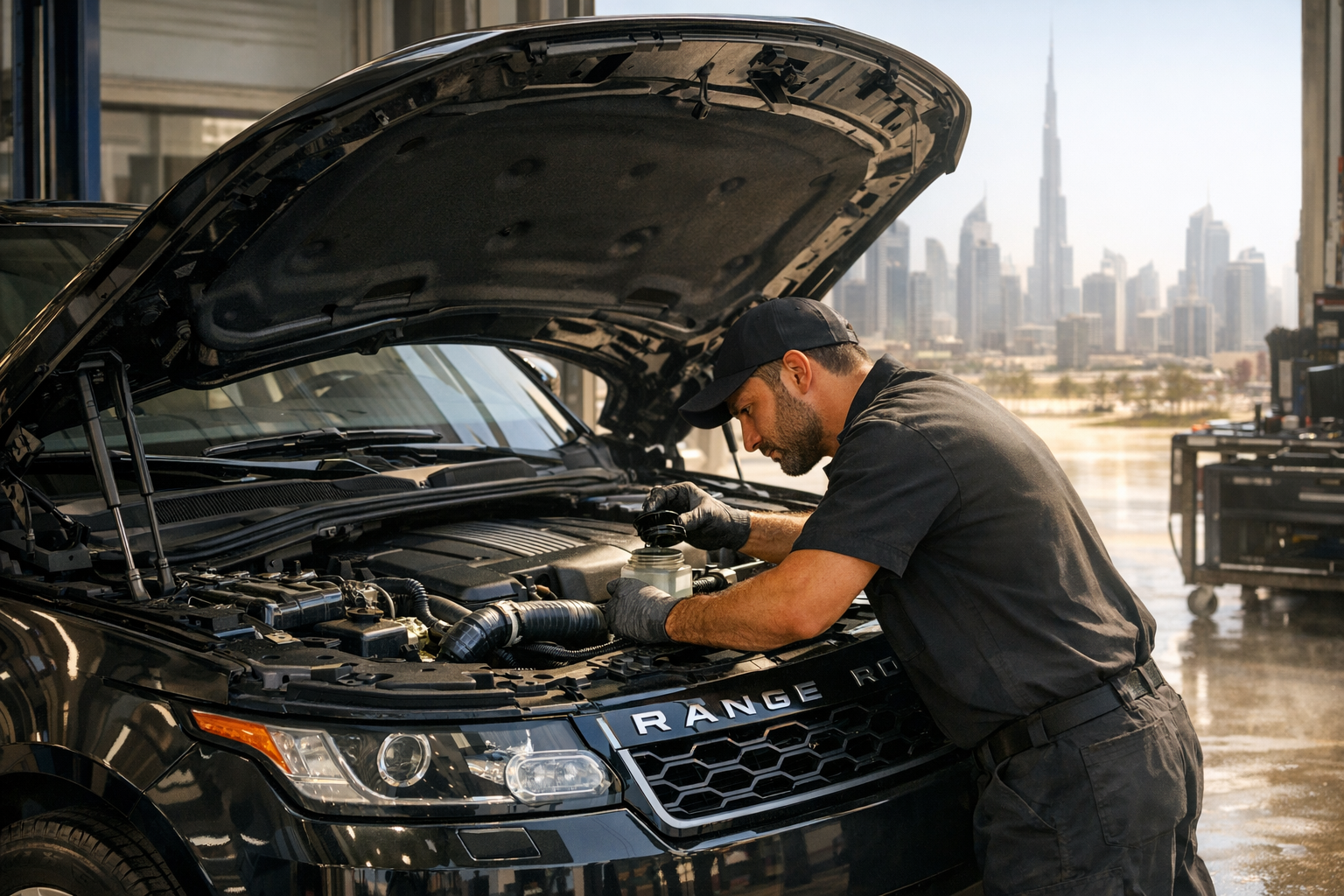
For owners in Dubai who want brand-focused knowledge and OE-grade parts, Euro Expert offers Range Rover coolant flush and overheating repair in Dubai performed by technicians trained specifically on Land Rover platforms. They ensure the correct OAT spec, proper system bleeding, and thorough diagnostics — so you drive through summer with confidence.
FAQ: Range Rover Cooling System in the UAE
What coolant does a Range Rover use?
Land Rover requires a phosphate-free, silicate-free OAT coolant meeting JLR specification TDS 2010 or equivalent, mixed 50/50 with deionised water.
How often should I flush Range Rover coolant in Dubai?
Every three years or 80,000 km in UAE conditions — shorter than the global recommendation due to extreme heat.
How much does a Range Rover coolant flush cost in Dubai?
Expect AED 500 to AED 1,200 depending on the model and scope of work.
Can I use tap water to top up my coolant?
No. Use only deionised or distilled water. Tap water introduces minerals that cause internal corrosion.
Why does my Range Rover overheat only in traffic?
At idle, cooling depends entirely on electric fans. A weak fan motor, failed relay, clogged radiator, or air lock will cause temperatures to spike when there is no ram air at speed.
When should I replace the water pump on a Range Rover in the UAE?
Proactively between 100,000 and 130,000 km — earlier if you hear bearing noise or spot weep-hole seepage.
Book a cooling-system inspection in Dubai today to prevent summer overheating. Contact Euro Expert’s Range Rover repair centre and keep your engine running cool all year round.