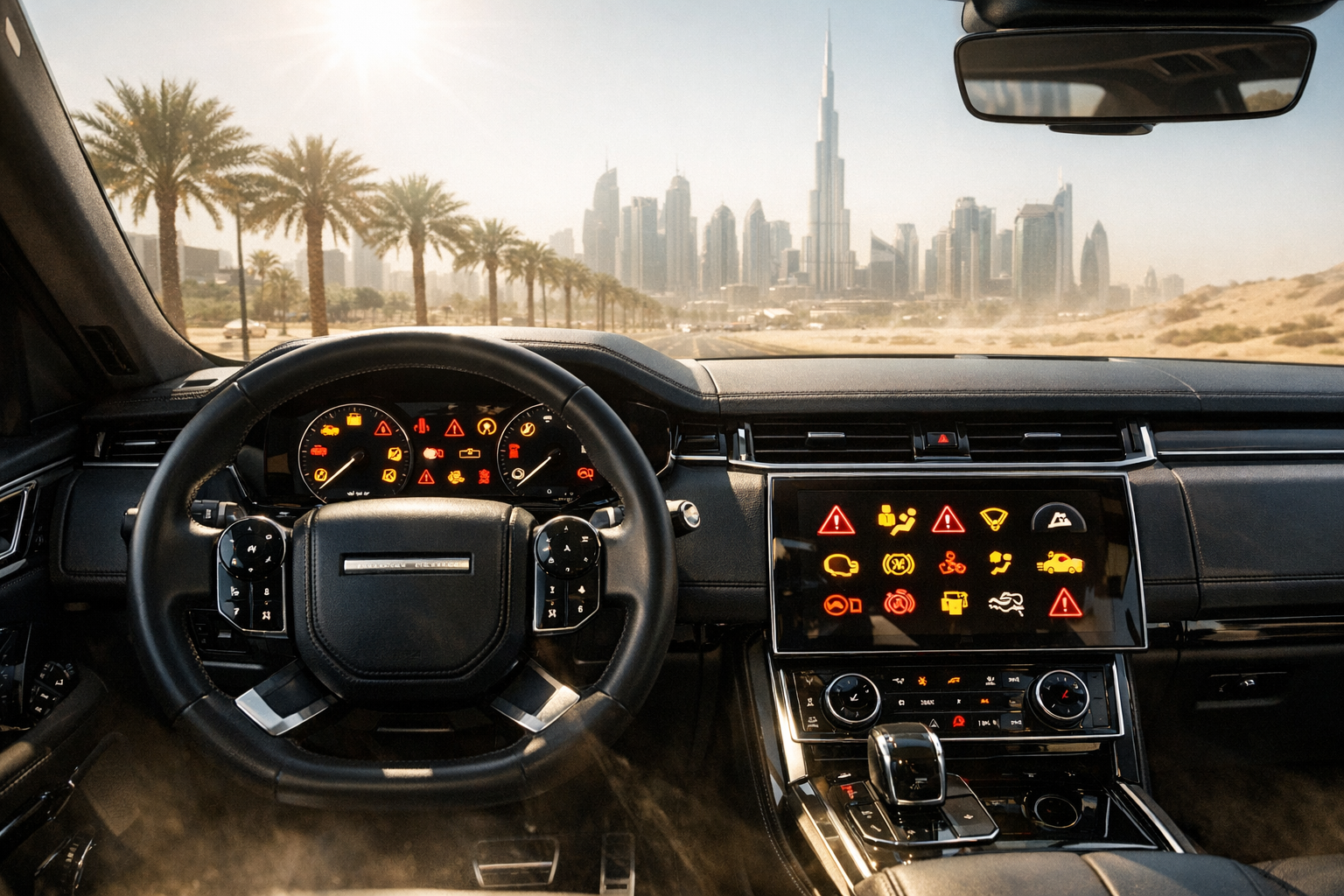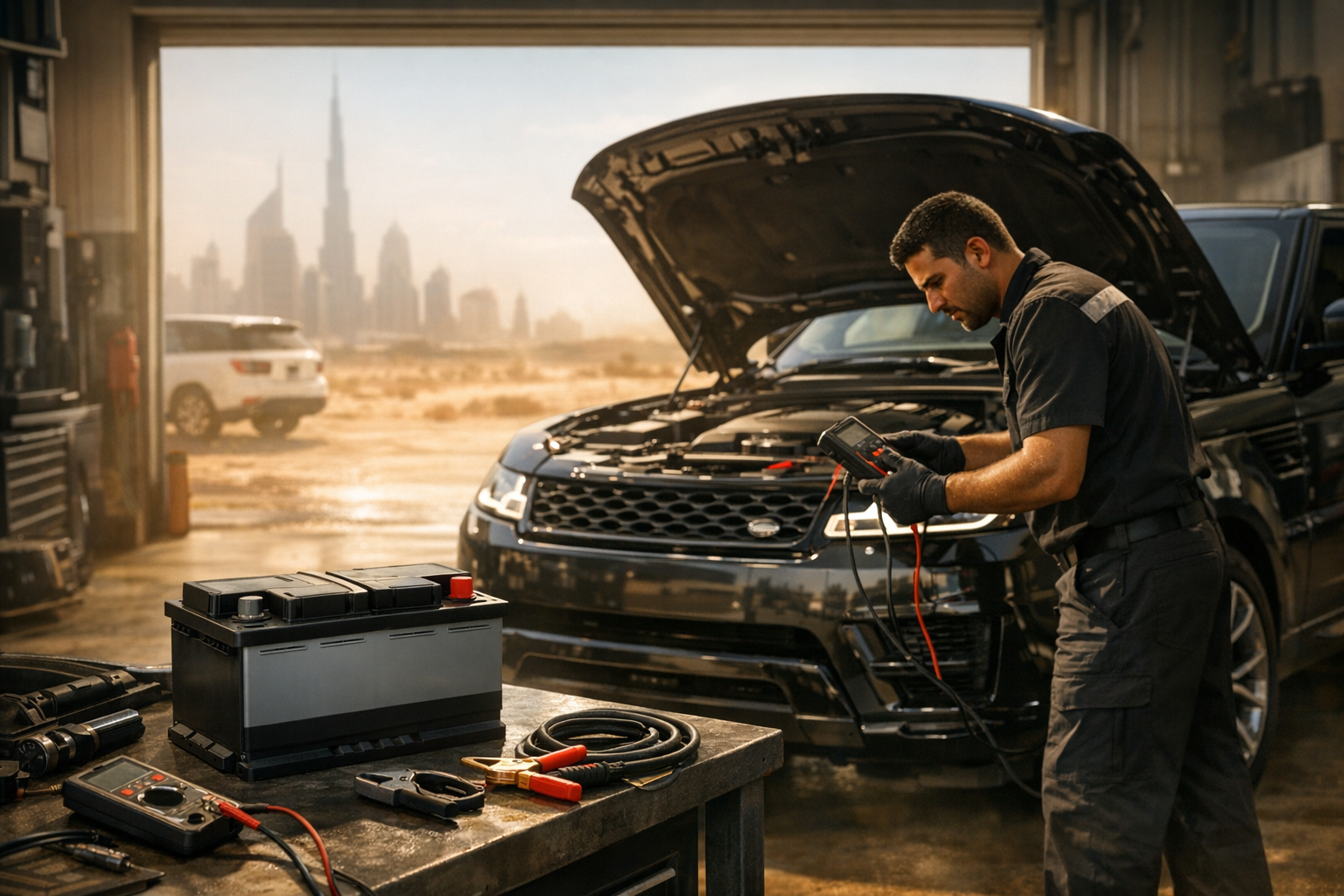
In Dubai’s 45°C+ summers, the right AGM battery and a few simple habits can prevent most Range Rover no-starts. While most drivers worry about engine overheating, it’s the battery that often fails first — and Range Rover owners face unique challenges.
Between air suspension compressors, advanced infotainment systems, and multiple control modules that never fully sleep, a Range Rover’s electrical demands push even premium batteries to their limits. Here’s how to stay ahead of flat-battery surprises in GCC conditions.
Best AGM Battery Spec for Dubai/UAE Heat (H8/Group 49)
Not all batteries survive a UAE summer equally. A spec that works in London won’t last through July in Dubai. When shopping for a Range Rover battery replacement in Dubai, prioritise these three factors.
Choose AGM Over Conventional Flooded Batteries
Range Rovers from 2013 onward are engineered for AGM (Absorbent Glass Mat) batteries, which handle deep cycling and high-temperature stress far better than traditional lead-acid units. Never downgrade to a standard flooded battery — the vehicle’s intelligent charging system expects AGM chemistry and will overcharge a conventional unit.
Prioritise Heat Tolerance Over CCA
CCA (Cold Cranking Amps) matters in cold climates, but in the UAE you want a battery rated for high reserve capacity and thermal resilience. Look for AGM battery UAE-rated units with reinforced plate separators and enhanced electrolyte formulations designed for ambient temperatures above 45°C. A battery with 20% lower CCA but superior heat resistance will outlast a high-CCA unit every time in Gulf conditions.
Stick to OE-Equivalent Sizing
Range Rovers use specific group sizes — typically BCI Group 49/H8 for full-size models. An undersized battery may physically fit but will be chronically overworked by the vehicle’s parasitic loads, leading to premature failure within months.
Key takeaway: In UAE heat, state of charge and thermal resilience matter more than raw CCA.
5 Maintenance Habits That Extend Range Rover Battery Life in Heat
Even the best AGM battery will fail prematurely without proper care. These habits can add one to two years of service life in Dubai’s climate.
- Drive at least 20–30 minutes twice a week. Short city trips never allow the alternator to fully replenish what the start cycle consumed. If your Range Rover sits idle for extended periods, connect a smart trickle charger rated for AGM batteries (CTEK MXS 5.0 or similar) to maintain optimal charge.
- Park in shade or underground. A battery operating at 35°C in a basement car park will last measurably longer than one consistently baking at 60°C under direct sun. Underground parking reduces under-bonnet temperatures by 20–25°C on peak summer days.
- Clean terminals every quarter. Corrosion builds faster in humid coastal air along the Gulf. Scrub terminals with a baking soda solution, apply dielectric grease, and ensure clamps are torqued properly. Loose connections create resistance, generate heat, and accelerate degradation.
- Monitor resting voltage proactively. A healthy battery should read 12.6V or above at rest. Anything below 12.4V indicates partial discharge that causes sulphation (crystalline buildup on lead plates) — the number-one killer of batteries in hot climates.
- Replace on schedule, not on failure. In the UAE, even a quality AGM battery rarely exceeds 3–4 years. Don’t wait for a no-start. If your battery is approaching three years old, book a Range Rover battery test in Dubai before summer hits.
Key takeaway: Regular driving, shade parking, and quarterly terminal checks are your cheapest insurance against a dead battery.
Parasitic Drain on Range Rovers: Common Dubai Causes and Fixes
This is where Range Rovers earn their reputation for going flat overnight. Modern models draw 30–50mA in normal sleep mode, but numerous culprits push that figure into dangerous territory — sometimes 300–500mA or more.
Dashcam Battery Drain
Aftermarket dashcams hardwired to always-on circuits are among the most common offenders in Dubai. If your dashcam lacks a voltage cutoff module, it will drain your battery to zero while parked at the office or airport. Always wire dashcams through a dedicated battery protection device with a low-voltage disconnect set at 12.2V.
Keyless Entry Module Wake Cycles
Keyless entry receivers that fail to enter sleep mode — often triggered by key fobs stored too close to the vehicle — keep RF scanning active 24/7. Store spare keys in a Faraday pouch or away from exterior walls adjacent to your parking spot.
Air Suspension Battery Drain
Air suspension compressors can cycle unexpectedly due to slow leaks in airbags or valve blocks. If your Range Rover sits noticeably lower after a few hours, the compressor may be running intermittently and drawing significant current each time. This is particularly common on Sport and full-size models with 80,000+ km on the original air springs.
Faulty Boot Latch and Interior Lighting Circuits
A boot latch switch or door pin switch that doesn’t register as closed will keep body control modules awake indefinitely, drawing 150–400mA continuously.
How to Diagnose the Drain
Identifying the source requires a systematic current-draw test with a DC clamp meter and methodical fuse-pulling to isolate the offending circuit. It’s precise work that benefits from experience with Land Rover wiring architecture. If you suspect a parasitic drain, get a parasitic-drain diagnosis in Dubai before replacing a battery that may not be the root problem.
Key takeaway: A new battery won’t fix a parasitic drain — diagnose the draw first, then replace if needed.
When to Seek Professional Range Rover Battery Help in Dubai
If you’re experiencing repeated flat batteries, slow cranking, or dashboard warnings related to the charging system, it’s time for a proper diagnostic — not just a swap-and-hope replacement.
Warning signs that demand expert attention:
- Battery dies overnight or after 2–3 days parked
- Slow cranking that worsens in afternoon heat
- “Battery charging system fault” message on the dash
- Vehicle sitting visibly lower on one corner after parking
- New battery failing within 6–12 months of installation
The specialists at Euro Expert have extensive experience with Range Rover electrical systems and can perform comprehensive parasitic drain analysis, charging system testing, and battery health assessments using manufacturer-level JLR diagnostic tools (SDD/Pathfinder).
Don’t Wait for a No-Start This Summer
A proactive approach to battery care isn’t just about convenience. In Dubai’s peak summer heat, a no-start situation in an exposed car park can quickly become a safety concern — especially with children or pets.
Invest in the right AGM battery, maintain it with the habits above, and address parasitic drains early. Your Range Rover will reward you with reliable starts, season after season.
If you’re facing repeat no-starts or slow cranking, book a same-day Range Rover battery test and parasitic-drain diagnosis in Dubai with Euro Expert. Their team will pinpoint whether you need a new battery, a drain fix, or both — and get you back on the road before the afternoon heat sets in.