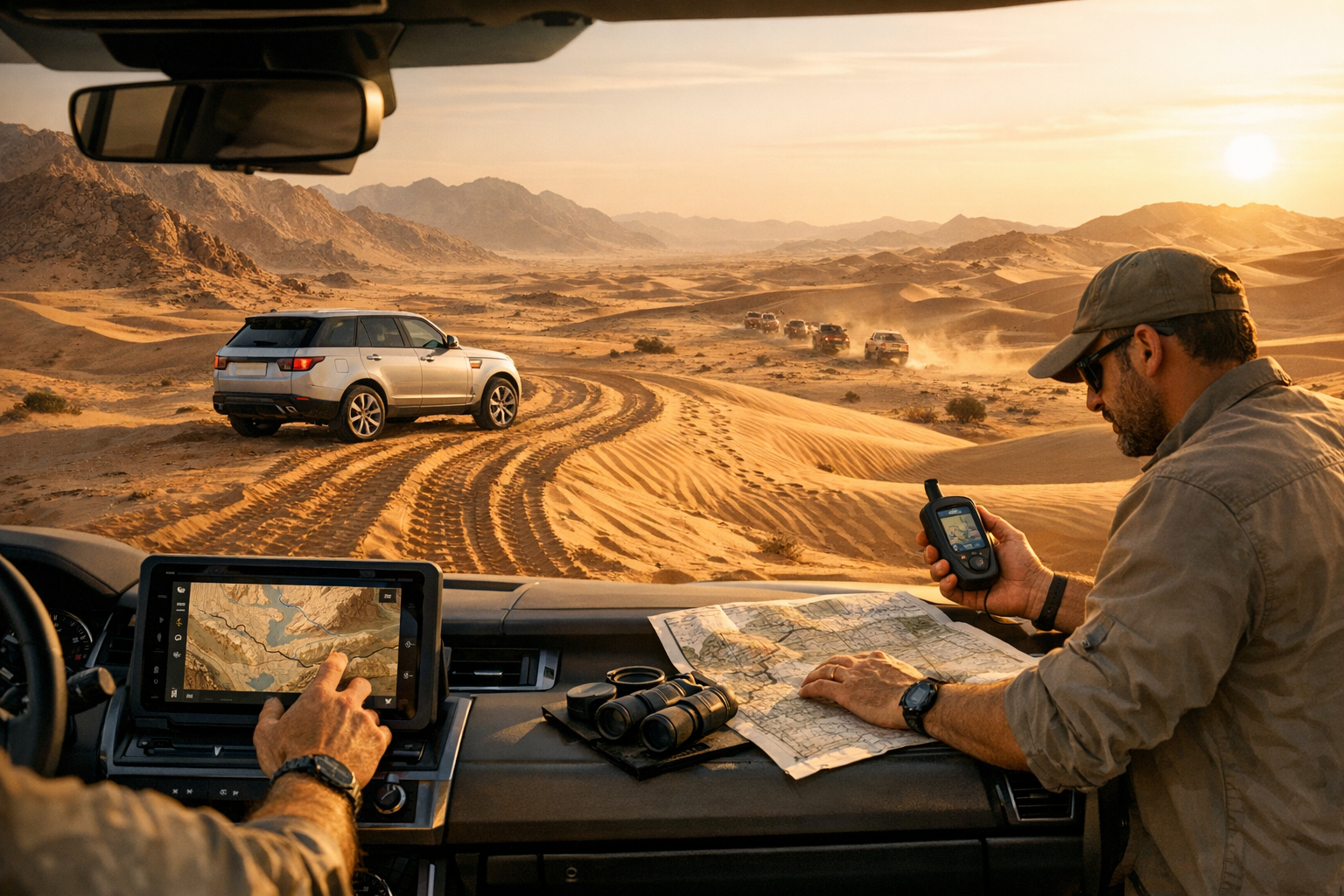
Driving a Range Rover through the UAE after dark presents challenges you won’t find in European or North American driving guides. Airborne desert dust scatters light in unpredictable ways. Unmarked camels wander near highway shoulders on the E11 Sheikh Zayed Road, the E44, and the Dubai–Hatta road. You transition from six-lane motorways to unlit desert tracks in minutes.
Your lighting setup and driver-assistance calibration can mean the difference between a relaxed cruise and a dangerous situation. Here’s how to get every system working at its best for desert night driving in the UAE.
Why Dusty Air Glare Beats High Beams on UAE Highways
Fine sand and dust particles suspended in the air act like millions of tiny mirrors. When your Range Rover headlights hit this curtain of particulates, light scatters back toward you, creating a bright haze that reduces forward visibility — similar to fog, but often less obvious until you’re already compromised.
This is why switching to high beam on a dusty night makes things worse. The increased light output bounces straight back into your eyes, whiting out the road ahead. On stretches of the E11 between Abu Dhabi and Dubai, or heading inland toward Al Ain, this effect intensifies because traffic kicks more particulates into the air.
The rule is simple: in dust, less light aimed upward means more visibility for you.
Best Range Rover Headlight Settings for Dubai and Abu Dhabi Nights
Adaptive LED headlights on modern Range Rovers — Sport, Velar, and full-size models from 2018 onwards — offer multiple beam configurations. For dusty UAE highways, the correct setup makes a significant difference.
Keep the beam pattern in its lowest effective setting. The automatic high-beam assist tends to activate on dark stretches, but in dusty conditions, manually override it to maintain dipped beams. This keeps light below the densest dust layer and reduces glare scatter.
Disable auto high beam before you leave. On the Dubai–Hatta road or desert tracks near Liwa, the system reads an absence of oncoming traffic and pushes to full beam. In dust, this blinds you rather than helping you.
Check headlight alignment regularly. Off-road excursions shift suspension geometry, and even slight misalignment pushes your beam pattern upward — exactly where it catches more dust. Professional headlight alignment in Dubai every 5,000 km is sensible if you mix highway and desert driving.
Clean headlight lenses frequently. Sandblasted lenses develop micro-scratches that diffuse light output and increase glare. Polishing compound or protective film replacement keeps beam focus sharp and directional.
When to Use Front and Rear Fog Lights in Desert Dust
Front fog lights are your best tool for dust. They sit low on the bumper and cast a wide, flat beam that stays beneath the worst of the suspended dust layer. On particularly hazy nights, fog lights in dust often provide better usable visibility than your main adaptive LED headlights alone.
When to switch them on: Any time you notice a visible haze reducing your ability to see road markings or vehicles ahead clearly. This happens frequently on inland routes between October and April when overnight temperature drops trap dust at low altitude.
Rear fog lights are equally critical. On low-visibility nights along desert highways, a single rear fog light makes your Range Rover visible to following traffic much earlier than standard tail lights. RTA regulations permit their use when visibility drops below 100 metres.
When to switch them off: As soon as visibility improves or traffic is close behind you. Leaving rear fogs on in normal conditions dazzles other drivers and carries fines.
Calibrating Cameras and Radar for Camel-Prone Routes (E11, E44, Dubai–Hatta)
Range Rover models equipped with autonomous emergency braking, adaptive cruise control, and forward-collision warning rely on forward-facing cameras and radar modules. Dust accumulation on these sensors degrades performance significantly — sometimes silently, without dashboard warnings.
Clean radar modules and camera housings behind the windscreen and in the front grille before every long night drive. A microfibre cloth and sensor-safe cleaner takes two minutes and can restore full detection range.
Understand system limitations on animal crossings. Adaptive cruise control may not detect stationary or slow-moving camels reliably in dusty conditions. Camel crossings at night are a serious risk on rural routes near Liwa, along the Dubai–Hatta road, and on unlit sections of the E44. Never rely solely on ACC for collision avoidance.
Activate thermal night vision if equipped. Higher-spec Range Rover models include thermal imaging systems unaffected by dust particles. Thermal cameras detect body heat regardless of visibility conditions. Keep this display active on routes known for animal crossings — it can reveal a camel at 300 metres when your headlights show nothing.
Reset adaptive systems after off-road use. Suspension height changes and impacts can shift sensor alignment. If your forward-collision warning or lane-keeping assist behaves erratically after a desert excursion, the system needs professional recalibration.
Night Drive Pre-Check: 5 Steps Before You Leave
Complete this checklist before any night drive on UAE desert roads:
- Clean all headlight lenses, fog-light lenses, and rear light clusters with a soft cloth to remove dust film.
- Wipe the front radar module (in the grille) and the windscreen camera housing with a microfibre cloth.
- Disable auto high beam and confirm dipped beams provide a level, focused pattern on a wall or garage door.
- Test front and rear fog lights — confirm all bulbs and LEDs function correctly.
- Check tyre pressures and suspension height are at highway settings, ensuring headlight alignment hasn’t shifted from an earlier off-road drive.
This takes less than ten minutes and dramatically improves your safety margin.
RTA Compliance: Lighting Rules You Must Follow
UAE traffic law is specific about lighting use, and enforcement is active:
- Driving with high beams in traffic carries fines.
- Operating without functioning headlights or tail lights results in penalties.
- Aftermarket LED upgrades that haven’t been tested and approved can result in vehicle impounding during inspections.
- Rear fog lights used unnecessarily in clear conditions attract fines.
Stick with OEM-specification adaptive LED headlights to stay compliant in Dubai, Abu Dhabi, Sharjah, and across all emirates.
Keeping Your Lighting and Sensors in Peak Condition
Desert conditions accelerate wear on every lighting component, sensor housing, and electrical connector. Dust infiltration, extreme heat cycling between 50°C days and cooler nights, and vibration from off-road use all degrade performance over time.
Common issues for Range Rovers in the UAE include:
- Headlight condensation from thermal cycling
- Corroded fog-light connectors
- Radar module misalignment after off-road driving
- Adaptive headlight motor failures from dust ingress
- Camera lens hazing from UV and sand exposure
These aren’t problems you notice gradually — they reduce safety in sudden, situational ways, typically discovered only when you need maximum performance from your systems on a dark, dusty road.
Need headlight alignment, fog-light diagnostics, or sensor calibration in Dubai? The specialists at Euro Expert handle these Land Rover-specific systems daily. Book Range Rover headlight alignment and adaptive lighting calibration in Dubai to ensure every system performs as designed when conditions demand it. They service Range Rover owners across Dubai, Abu Dhabi, Sharjah, and Al Ain.
Frequently Asked Questions
Should I use high beams in dusty UAE conditions?
No. Dust scatters high-beam light back at you, reducing visibility. Stay on dipped beams and use low-mounted fog lights for the best forward view.
When should I turn on rear fog lights in Dubai?
Use them only when visibility is severely reduced — roughly under 100 metres — to avoid dazzling drivers behind you. Switch them off as soon as conditions improve.
How do I set up Range Rover adaptive headlights for sand haze?
Disable auto high beam, keep a low dipped-beam pattern, and verify headlight alignment after any off-road use. Clean lens surfaces before driving.
Can adaptive cruise control see camels at night?
Dust and low contrast reduce detection reliability significantly. Never rely on ACC for stationary or slow-moving animals on rural UAE routes.
Do thermal night vision systems work in dust?
Yes. Thermal imaging detects body heat and is far less affected by airborne dust than cameras or your own eyes. Keep it active on rural routes with known animal crossings.
How often should I get headlight alignment checked in Dubai?
Every 5,000 km if you regularly drive off-road, or immediately after any desert excursion that involved rough tracks or significant suspension articulation.
Final Thoughts
Desert night driving in the UAE rewards preparation and punishes complacency. Your Range Rover has the technology to handle dusty highways and unlit desert tracks brilliantly — but only if every system is clean, calibrated, and correctly configured.
Take the time before each night drive. Check your lights. Clean your sensors. Know which driver aids you can trust and which need your own vigilance as backup.
The desert is beautiful after dark. Make sure you see it clearly — and that other drivers see you.
Ready to ensure your Range Rover’s lighting and safety systems are performing at their best? Book a service with Euro Expert in Dubai for professional headlight alignment, adaptive lighting diagnostics, and sensor calibration. Serving Range Rover owners in Dubai, Abu Dhabi, Sharjah, and Al Ain.