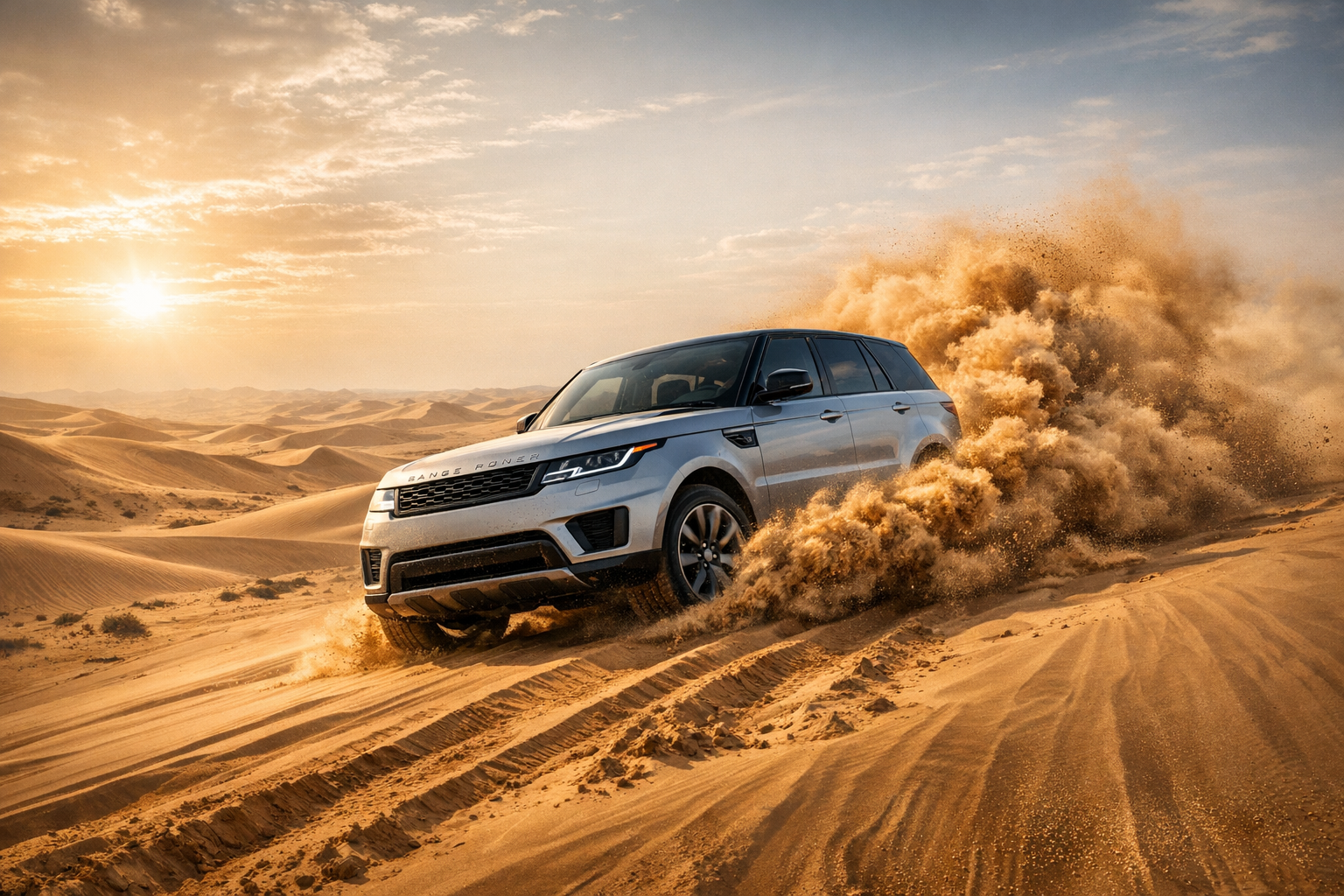
The UAE’s desert landscape offers some of the most exhilarating off-road driving experiences in the world. From the sweeping red dunes of Al Faya to the vast expanses of the Liwa desert near Abu Dhabi, Range Rover owners have a dune-bashing playground unlike any other right at their doorstep. But venturing onto sand without proper preparation can quickly turn an adventure into an ordeal. Here’s your practical guide to Range Rover sand driving in the UAE—covering tyre pressures, Terrain Response settings, and recovery essentials so you get it right every time.
Best Tyre Pressure for Sand in the UAE (Range Rover)
Tyre pressure is the single most important adjustment you’ll make before hitting the sand. On tarmac, your Range Rover’s tyres are typically inflated to around 32–36 PSI depending on the model and load. On sand, those numbers need to come down significantly.
For most desert driving conditions in Dubai, Abu Dhabi, and across the UAE, deflating your tyres to between 15–18 PSI is the sweet spot. This wider footprint distributes the vehicle’s weight across a larger surface area, preventing the tyres from digging into soft sand. Whether you’re driving a Range Rover Sport, Vogue, or Defender, this range works consistently well on loose dunes. For harder-packed sabkha (salt flats), you can stay slightly higher at around 20–22 PSI.
A few essential rules to remember:
- Always carry a portable air compressor to reinflate before returning to paved roads. Driving on tarmac with deflated tyres damages sidewalls and generates dangerous heat.
- Deflate evenly across all four tyres. Uneven pressure creates unpredictable handling.
- Never go below 12 PSI unless you’re in an extreme recovery situation and fully understand the risk of debeading.
- Check pressures when tyres are cool, ideally before the morning sun heats the sand.
Terrain Response Sand Mode: Range Rover Settings for UAE Dunes
Range Rover’s Terrain Response system is one of the most sophisticated off-road technologies available, and using it correctly makes a remarkable difference when dune bashing in the UAE.
Terrain Response 2 (automatic mode) can detect surface conditions and adjust accordingly, but for dedicated desert driving, manually selecting Sand mode is recommended. This mode holds gears longer, reduces throttle sensitivity to prevent wheel spin, and adjusts the differentials and stability systems for optimal traction on loose surfaces.
Key tips for using Terrain Response in sand:
- Engage Sand mode before you leave firm ground. Switching modes while already stuck limits the system’s effectiveness.
- Maintain momentum. Sand mode is designed to work with steady throttle inputs. Avoid sudden acceleration or braking on dune faces.
- Use Hill Descent Control cautiously on steep dune descents. While effective on moderate gradients, some UAE dunes—particularly in Liwa and the Al Faya region—have sharp drop-offs that require manual control and experience. Scout the descent before committing.
- On newer models with Terrain Response 2, the system pairs beautifully with adjustable air suspension. Raising the vehicle to maximum ride height before entering soft sand gives you essential ground clearance and approach angles for larger dunes.
For most Range Rover owners exploring Dubai’s desert outskirts or heading deeper into Abu Dhabi’s Empty Quarter, Sand mode with air suspension raised to its highest setting is the go-to configuration.
Essential Recovery Gear for UAE Desert Driving
Even experienced drivers get stuck. Carrying the right recovery equipment isn’t optional—it’s responsible off-road driving.
Your desert kit should include:
- Recovery boards (such as MaxTrax or similar traction aids)—the fastest way to self-recover from soft sand without assistance.
- A kinetic recovery rope (not a tow strap—kinetic ropes stretch and generate pulling force safely, reducing shock loads on your Range Rover’s chassis).
- A rated shackle set compatible with your vehicle’s recovery points.
- A long-handled shovel for clearing sand from around tyres and the undercarriage.
- A tyre deflator and quality 12V air compressor rated for heavy-duty use.
- Adequate water (minimum 5 litres per person—more in summer months).
- A fully charged phone with offline GPS maps downloaded. Mobile signal is unreliable deep in the desert.
Never drive into the desert alone. Travel in a convoy of at least two vehicles, and always inform someone of your planned route and expected return time.
UAE Desert Driving Etiquette and Safety Tips
The UAE’s off-road community is built on mutual respect and safety awareness. Whether you’re dune bashing near Dubai or on a weekend trip to Liwa, following these guidelines keeps everyone safe:
- Always follow established tracks when possible to minimise environmental damage.
- Give right of way to vehicles climbing dunes—they need momentum and cannot stop easily.
- Never park on the blind side of a dune crest where approaching vehicles cannot see you.
- If you spot a stuck vehicle, stop and offer assistance. It’s both customary and could be life-saving in summer temperatures exceeding 50°C.
- Drive early in the morning or late afternoon when temperatures are lower and the sand is firmer.
Keep Your Range Rover Desert-Ready
Regular desert driving places unique demands on your vehicle. Sand infiltrates air filters, suspension components endure constant articulation, and cooling systems work overtime in extreme UAE heat. Without proper maintenance, these stresses accelerate wear on drivetrains, turbochargers, and electronic systems.
Scheduling routine inspections with specialists who understand these demands is essential for longevity and safety. Before your next dune trip, book a pre-desert health check with Euro Expert—specialists in Range Rover repair in Dubai—to protect your drivetrain, cooling system, and suspension components. Their team ensures your vehicle is always prepared for whatever the desert demands, from routine Range Rover service in Dubai to comprehensive post-desert inspections.
Final Thoughts
Mastering sand driving in your Range Rover is a skill developed over time. Start with smaller dunes around Dubai’s Lahbab desert, practise your throttle control, and build confidence gradually before tackling the larger formations in Liwa or the Empty Quarter. With the right tyre pressures, the correct Terrain Response settings, and proper recovery gear, the UAE’s deserts become not a challenge to fear but an experience to savour—every single weekend.
Frequently Asked Questions
What is the best tyre pressure for a Range Rover Sport on UAE sand?
For most soft sand conditions, deflate to 15–18 PSI; this applies to the Range Rover Sport, Vogue, and similar models, providing the wider footprint needed to stay on top of loose sand.
Should I use Terrain Response 2 auto or Sand mode in the desert?
Manually select Sand mode for dedicated dune driving—it optimises throttle mapping, gear changes, and differential settings more aggressively than the automatic detection mode.
Can I drive on tarmac at 18 PSI after dune bashing?
No. Always reinflate to the manufacturer’s recommended pressure (typically 32–36 PSI) before driving on paved roads, as low-pressure tarmac driving causes dangerous heat build-up and sidewall damage.
How do I recover a bogged Range Rover without damage?
Clear sand from around all four tyres, place recovery boards in front of the drive wheels, and gently accelerate in Sand mode with low, steady throttle—avoid spinning the wheels aggressively.
What gear do I need for dune bashing in Dubai?
At minimum, carry recovery boards, a kinetic recovery rope, rated shackles, a shovel, a tyre deflator, an air compressor, and at least 5 litres of water per person.
Is Hill Descent Control safe on steep UAE dunes?
It works well on moderate descents, but on very steep or blind dune faces—common in Liwa and Al Faya—experienced drivers prefer manual control to maintain better situational awareness.