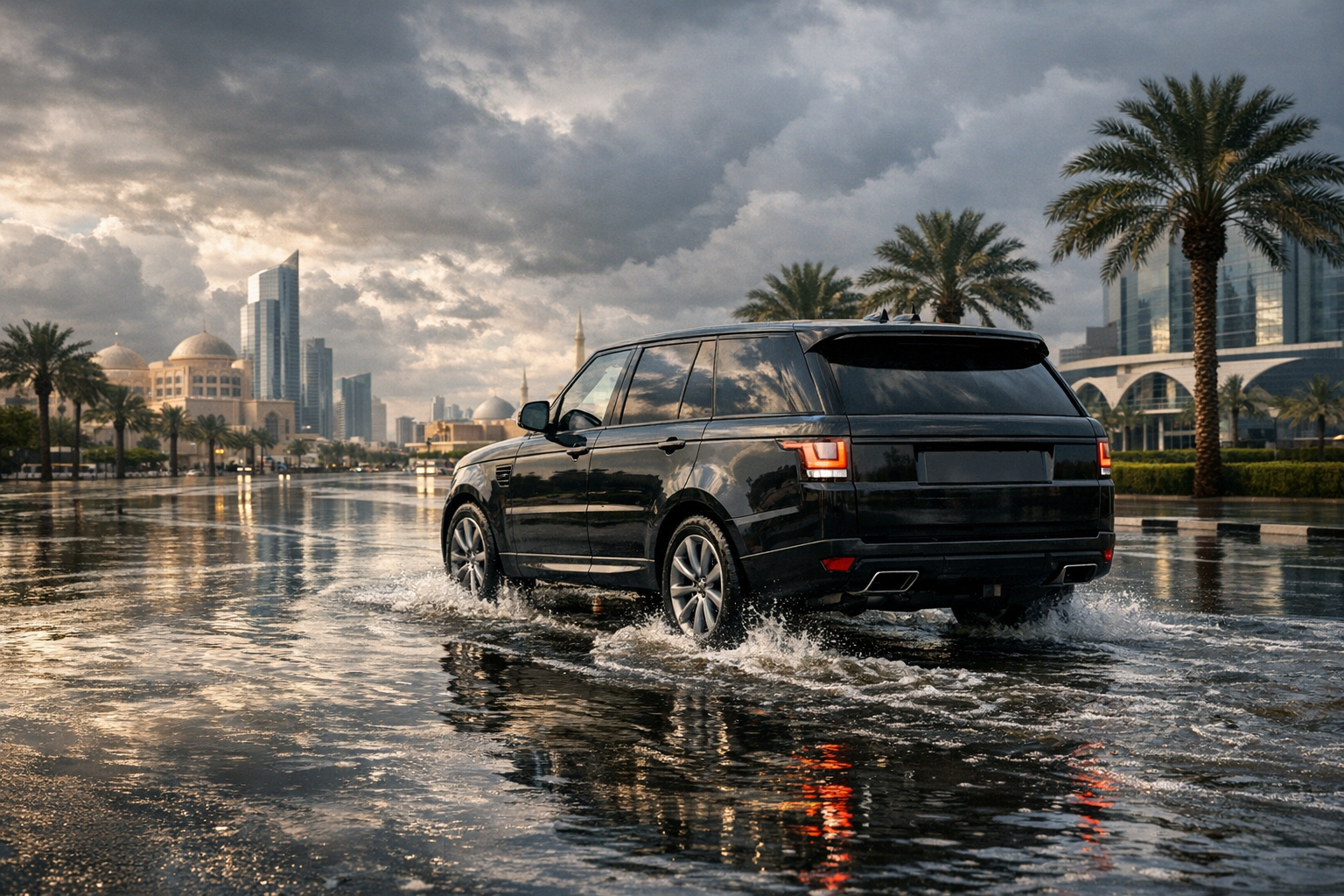
Driving a Range Rover in Dubai and across the UAE means sudden floods and wadi crossings are real possibilities, not rare events. From winter storms that submerge city streets in minutes to flowing mountain wadis that cut across gravel tracks, water hazards come without warning. This guide covers safe Range Rover wading depth, how to use Wade Sensing, the best Terrain Response settings, and post-flood care to protect your 4×4 from hidden damage long after the water recedes.
Quick Wading Checklist
Before you enter any water, run through these steps:
- Assess depth, current, and exit point visually before committing
- Raise air suspension to maximum off-road height
- Select Wade or Mud & Ruts mode; engage low range if needed
- Enter at walking pace; maintain a gentle bow wave ahead of the engine bay
- Avoid sudden throttle or gear changes; never tail another vehicle closely
- Exit, dry brakes immediately, and inspect the underbody and electricals
Keep this sequence in mind every time. Now let’s break down each stage in detail.
What Is a Safe Range Rover Wading Depth in UAE Floods?
Range Rover models generally offer a maximum wading depth between 850mm and 900mm, depending on generation and specification. However, that figure assumes still water on a firm, level surface — conditions rarely found during a real UAE flash flood or wadi crossing.
Before entering any water:
- Look for reference points such as kerbs, barriers, or tyre marks from other vehicles to estimate depth.
- Assess the flow rate. Moving water generates lateral force that can destabilise even a 2.5-tonne vehicle. If you can see ripples forming against fixed objects, proceed with extreme caution or find an alternative route.
- Check the exit point. Wadis can have soft, silted beds that shift with every rainfall. If you cannot see where you’ll drive out, don’t drive in.
- Never follow another vehicle blindly. Their bow wave raises water levels around your air intake and can push depth well beyond what you estimated from shore.
If you’re unsure, turn around. A safe Range Rover wading depth in real conditions is always less than the laboratory maximum.
How to Set Up Terrain Response, Ride Height, and Low Range for Wading
Preparation takes thirty seconds and makes all the difference between a controlled crossing and a recovery bill.
1. Raise the Air Suspension
Access the ride height controls and select the maximum off-road height setting. This lifts the body, increasing clearance between the waterline and critical components — particularly the air intake, door seals, and electrical modules mounted low in the chassis.
2. Select the Correct Terrain Response Mode
Choose the Wade programme if your model offers it. Otherwise, select Mud and Ruts, which holds lower gears, delivers throttle smoothly, and reduces the risk of sudden power surges that push water higher than necessary around the front end.
3. Engage Low Range
For deeper or longer crossings, low range gives you finer speed control with minimal throttle input. The ideal wading pace is a steady walking speed — fast enough to create a gentle bow wave that pushes water away from the engine bay, but slow enough to avoid forcing water over the bonnet line or swamping the intake.
How Range Rover Wade Sensing Works (and Its Limits)
Fitted to newer Range Rover models, the Wade Sensing system uses ultrasonic sensors mounted in the door mirrors to measure water depth in real time. The reading displays on the central touchscreen alongside your vehicle’s maximum safe wading limit.
Key points to understand:
- The display updates continuously. Watch for sudden depth increases, which indicate unseen dips, drainage channels, or debris dams beneath the surface.
- If the system alerts you that depth is approaching the maximum threshold, stop accelerating immediately and assess whether reversing out is the safer option.
- Wade Sensing measures water at mirror height — not at the lowest point of the vehicle. It is a valuable aid, not a guarantee of safety. Submerged potholes, angled surfaces, and soft ground can all place the chassis lower than sensors indicate.
Use Wade Sensing to confirm your visual assessment, not to replace it.
Post-Flood Car Care in Dubai: After-Wading Checklist
This is where UAE conditions create hidden problems that many owners overlook. Floodwater in this region often carries fine calcium-rich sand, road salt, construction silt, and sewage debris that settle into places you cannot easily see. Corrosion and contamination begin quickly in high humidity.
Essential aftercare includes:
- Brake drying: Immediately after exiting water, drive slowly while lightly applying the brakes for 30 to 60 seconds. This clears moisture from the discs and pads, restoring full stopping power.
- Underbody inspection: Check for debris trapped around suspension arms, brake lines, driveshaft guards, and exhaust heat shields. Sand and gravel pack into these areas and cause premature wear or rattles.
- Differential and axle breather check: Silted breathers can pressurise axle housings, forcing contaminated water past seals and into gear oil. Left unchecked, this destroys bearings within weeks.
- Electrical connector inspection: Corrosion begins within hours in humid, salty conditions. Door-mounted modules, under-seat wiring harnesses, and the lower fusebox are common early failure points.
- Air filter check: Even if water didn’t reach the intake directly, airborne moisture and fine silt drawn through the snorkel path can saturate or clog the filter element, reducing performance and potentially allowing particles into the engine.
Many of these checks require a vehicle lift and trained eyes. If you’ve driven through anything deeper than mid-tyre height, a professional inspection is worthwhile insurance against expensive surprises surfacing weeks later.
If you’ve crossed deep or dirty floodwater, book a same-week inspection with Euro Expert for Range Rover repair in Dubai to prevent hidden water damage from compounding into major failures.
When to Book a Professional Range Rover Inspection in Dubai
Water damage is often invisible initially. It then manifests as warning lights, unusual noises, musty cabin smells, or premature component failure long after the event. Electrical faults from corroded connectors may appear intermittently at first, making them difficult to diagnose without specialist equipment.
If you’ve crossed deep water — particularly urban floodwater carrying sand, oil residue, or sewage runoff — have the vehicle inspected thoroughly rather than waiting for symptoms.
Prioritise inspection if:
- Wade Sensing showed depth above 600mm at any point during the crossing
- You noticed water entering the cabin, even briefly around door seals
- The crossing involved standing water with visible contamination or debris
- You heard unusual sounds from the drivetrain, brakes, or undercarriage afterwards
- Any warning lights appeared on the dashboard in the hours or days following
For owners across Dubai, specialists like Euro Expert offer Range Rover-specific diagnostics and can identify water intrusion damage early — before corroded wiring, contaminated fluids, or swollen cabin insulation turn a minor crossing into a major repair bill. Book your post-flood inspection for Range Rover repair in Dubai at euroexpert.ae.
The Bottom Line
Your Range Rover’s wading capability is genuine and impressive — engineered for exactly the conditions the UAE throws at drivers during storm season. But it remains a survival tool, not an invitation to treat every flooded underpass as a playground.
Assess every crossing independently. Use Wade Sensing and Terrain Response as aids rather than crutches. Maintain a calm, steady pace through the water. And always — always — follow up with proper aftercare. In the UAE’s harsh post-flood conditions, what you do after the crossing matters just as much as how you drove through it.